Search This Blog

Monday, February 21, 2011

Mother of 3 Arrested for Taking Pictures of Tourist Attraction at Airport


This case is a frightening example of what can happen when a photographer encounters ignorant bullies with badges. According to the complaint filed in Federal Court, Nancy Genovese, a mother of three, was driving home on County Road 31 past Gabreski Airport in Suffolk County. Gabreski Airport displays a decorative helicopter shell by the roadway to the public, which is visible to all who pass by.

Nancy Genovese stopped her car on the side of the road across the street from the airport in an area that is open and accessible to the public, and crossed over the road to the airport entryway that is also open and accessible to the public to take a picture of the helicopter display. While still in her car, she took a picture of the decorative helicopter shell with the intention of posting it on her personal “Support Our Troops” web page.

As Nancy Genovese was preparing to drive away, she was stopped and approached by Robert Iberger, a lieutenant with the Southampton Town Police. Lieutenant Iberger demanded to know why she was taking photographs. Nancy showed the lieutenant her camera, but Lieutenant Iberger grabbed her camera and handled it “without care”. In an attempt to prevent the lieutenant from damaging the camera, Nancy removed her memory card, which Lieutenant Iberger confiscated. To date, Nancy’s memory card still has not been returned to her.

Lieutenant Iberger demanded that Nancy remain where she is, and he refused to allow her to leave. At this time, Lieutenant Iberger notified the Suffolk County Sheriff’s Office and the authorities at Gabreski Airport of Nancy’s presence outside the airport, and falsely and wrongfully informed them that she posed a terrorist threat.

Suffolk County Deputy Sheriff Robert Carlock responded to the scene, along with various members of the Suffolk County Sheriff’s Office. When Deputy Carlock arrived, he placed cameras on the roof of his vehicle, aimed at Nancy Genovese and her 18 and 20 year old sons who had come to the scene at this point to help their mother. Deputy Carlock ordered all three of them to stand directly in front of the cameras, and not to move.

Officials from the airport, as well as other local and federal law enforcement agencies also responded, including, without limitation, the Southampton Police Department, the Westhampton Police Department, the FBI, and the Department of Homeland Security. Nancy was questioned on the side of the road for approximately five to six hours, from about 6pm until midnight, denied food or water, and denied the opportunity to use a restroom, all without having received any warnings as to her rights.

Nancy Genovese also had a left lower leg injury just above her ankle that she had received earlier in the day and which, exacerbated by the stress and length of her roadside detention, was causing her to limp. When the officers saw this, they ordered her to expose her wound, which was bleeding, for no legitimate purpose, and with no regard for Nancy’s health or well-being. Members of the Suffolk County Sheriff’s Office used Nancy’s leg wound as another object to taunt her with, telling her that they were going to arrest her for an unreported knife wound.

Here’s where the story takes an interesting twist, and why I believe Nancy’s situation hasn’t received more press coverage. Before arriving at the airport to take a picture, earlier that day Nancy had been to the local shooting range with her rifle practicing her hobby, target shooting. During the first hour of questioning, Lieutenant Iberger searched Nancy’s vehicle, without her consent, and came across her unloaded rifle, which Nancy was legally carrying, in a locked case. Now some people throw up their arms (no pun intended) at this point, and say, “what does she want, she brought a rifle to the airport!”, but I would like to remind everyone that it is perfectly legal to drive around with an unloaded rifle in your car. Yes. Really. And Nancy did not enter the airport, she was parked alongside a public roadway. It is important to remember that no matter how you feel about firearms, nothing that Nancy did violated any laws.

Using force, Lieutenant Iberger pushed Nancy Genovese when she objected to the seizure of her rifle. Deputy Carlock taunted Nancy, asking in a disparaging tone, “You’re a real right winger, aren’t you?”, and stating in words or substance that she was never going to see her rifle again.

During the remainder of the six hours that Nancy Genovese was forcibly detained on the side of the road, she was taunted, verbally harangued, threatened, belittled, abused, humiliated and harassed by members of the Suffolk County Sheriff’s Office. For example, Deputy Carlock repeatedly referred to Nancy as “a right winger” and “tea bagger”, and threatened that they were going to arrest her for terrorism to make an example of her to other “tea baggers” and “right wingers”.

Around midnight, officials from the airport and federal law enforcement agencies determined that Nancy posed no terrorist or other security threat. Once most of the other law enforcement officials left the scene, Deputy Carlock ordered Nancy Genovese to be handcuffed by another member of the Suffolk County Sheriff’s Office. Before placed in handcuffs, Nancy attempted to give her purse containing her wallet and cell phone to her sons. Her wallet contained approximately $13,000 in cash, money she was holding to pay tuition that day for her son’s college and her daughter’s Catholic school tuition. Deputy Carlock refused to allow her sons to take her bag, and ordered her to leave it on the front seat of her unlocked vehicle, even after being informed of the value of its contents. When Nancy’s sons objected, Deputy Carlock threatened to arrest them if they touched it, and ordered them to leave the scene. Not knowing what to do, they left.

When Nancy’s sons responded to a call from the Suffolk County Sheriff’s Office in the early morning hours to pick up their mother’s vehicle from the roadside, they found $5,300 of the $13,000 missing. The money was never returned. In addition, the contents of the glove compartment box was missing, and there was damage to the body of the car, particularly around the trunk.

Around midnight, after her sons were ordered to leave upon threat of arrest, Nancy was transported, in handcuffs, to the Suffolk County Jail. While in a holding cell, Deputy Carlock continued to verbally harass Nancy, telling her “you will pay”, and admitting that they had nothing to charge her with, but that he would “find something in order to teach all right wingers and tea baggers a lesson.”

While in her holding cell, Nancy Genovese was interrogated by Suffolk County Undersheriff Caracappa without receiving any warnings as to her rights. Her requests to speak to a lawyer were ignored. Following her “interrogation”, Undersheriff Caracappa informed her that she was being arrested and charged with “terrorism.”

At this point, Nancy requested medial treatment for her bleeding and painful left leg. After several requests, and several hours later, she was taken to the Peconic Bay Medical Center by male members of the Suffolk County Sheriff’s Office, and handcuffed to a bed. A sonogram was performed on Nancy’s left leg from her ankle to her inner groin, requiring her to disrobe. Despite her and the doctor’s request for them to turn away, the two male Suffolk Deputies insisted on staring at Nancy while she disrobed, further humiliating her. She was prescribed antibiotics, and discharged back to the Suffolk County Jail, with instructions on proper care for her leg wound.

Once back at the jail, the Suffolk County Sheriffs denied her access to her antibiotics, and denied her proper care of her leg wound. This caused a serious and painful staph infection to develop.

The following morning, Nancy Genovese was briefly questioned at the Suffolk County Jail by two FBI agents. No federal complaints or charges were ever brought against Nancy. That same day, Nancy was transported in handcuffs and ankle shackles, with no regard for her ankle wound, to the Southampton Justice Town Court. The driver drove fast and recklessly, intentionally making abrupt turns and laughing. This caused Nancy, who was not secured by a seatbelt, but was instead restrained with her hands cuffed behind her and her ankles cuffed together, to roll about in the back of the vehicle, further exacerbating her leg injury. When she requested that the Deputy Sheriffs secure her with a seatbelt, they laughed at her, and the driver continued to recklessly swerve the vehicle.

Nancy Genovese was brought into the courthouse in handcuffs and leg restraints, and was violently pushed through the door by the Deputy Sheriffs. This added to Nancy’s humiliation, particularly since Nancy knew some of the courthouse employees and other people who were present. Both before and after arriving at the courthouse, Nancy repeatedly requested to speak with an attorney. All of her requests were ignored.

Despite never stepping foot onto airport property, Nancy Genovese was arraigned on a single misdemeanor charge of Criminal Trespass in the Third Degree. She was assigned a Legal Aid Attorney by the Judge. Undersheriff Caracappa and Deputy Carlock intentionally lied to the Judge about the circumstances surrounding Nancy’s arrest, including that she was a terrorist and had surveillance equipment in her car, and the judge set bail in the amount of $50,000.

Due to the excessive amount of bail, Nancy’s children needed more time to come up with the money, so Nancy was returned to the jail. The Legal Aid Attorney assigned to Nancy spoke with the Deputy and Undersheriff, and due to the conversation, directly afterwards informed Nancy that he was no longer her attorney, and that he was going to ask the court to place her on suicide watch.

Once back at the jail, Nancy Genovese was processed, including being issued prison “greens” to wear, and was photographed, fingerprinted, and eye scanned. Members of the Suffolk County Sheriff’s Department continuously verbally harassed Nancy. A woman in civilian clothes then interviewed Nancy. The woman told Nancy she was going to be placed in “general population.” During the interview, two men wearing “Suffolk County Emergency Response Team” jackets entered the room. One of them removed Nancy from the room and held her in the hallway outside of the interview room. From there, Nancy heard the woman who had interviewed her arguing with the other man, saying that “She is not suicidal.”

Despite the woman’s protests, Nancy was physically moved by the two men wearing “Suffolk County Emergency Response Team” jackets to another room. There, another woman who identified herself as a nurse administered, without Nancy’s consent, two injections into Nancy’s arm. One of the men held Nancy’s head so that she could not see what was being done, while the other man held Nancy’s arm down. Despite her demands to know what they were doing, no one answered her. Nancy experienced bruising and swelling in her neck and arm long after she was released from custody.

Nancy was then escorted by the two men into a cell area, where she was forced to disrobe and put on a “suicide gown”, consisting of a heavy, jacket-type blanket that fastens around the body with Velcro. Nancy was not permitted to wear undergarments under the blanket. Nancy was required to wear this same “suicide gown” for the next several days. After three days, Nancy was evaluated by a psychiatrist who determined her to be of sound and stable mind, and immediately removed her from suicide watch.

Later that day, bail was posted, and Nancy was able to go home. Subsequently, all charges against Nancy were dismissed.

Upon Nancy’s release, Undersheriff Caracappa issued a press release in response to media inquiries, titled “Armed Woman Arrested for Trespassing at Suffolk County Gabreski Airport”, which falsely stated that Nancy had been taking pictures of the airport and surrounding security”, and that she became hysterical, and began “screaming and flailing around” when confronted. Undersheriff Caracappa also falsely reported that Nancy had surveillance equipment, 500 rounds of ammunition, and “scary weapons” in her car, and that she was a right-wing extremist and terrorist, and that she had been at the airport trespassing several times and had been warned to stay away. Upon further inquiry, it turns out that Nancy had never trespassed at the airport before, had never been warned by anyone to “stay away” before, had no “surveillance equipment” of any kind other than her point and shoot camera, and certainly was not a terrorist. Undersheriff Caracappa has refused to issue a retraction or correction.

Nancy has filed a Federal Lawsuit seeking up to 70 million dollars from the Town of Southampton, the County of Suffolk, Lieutenant Iberger, Undersheriff Caracappa, Deputy Carlock, Lieutenant Leuete, and various other employees of the Suffolk County Sheriff’s Department. The lawsuit is still ongoing.

EDITOR’S NOTES:

All of the alleged facts discussed in this article have been taken directly from the court documents filed in this case.
Nancy Genovese was on public property the entire time. At no time did she trespass onto airport property, which is why the trespassing charge (the only charge against her) was dismissed.
Here is the google maps view of the airport entrance, and the helicopter on display.
Although Undersheriff Caracappa released a statement saying that Nancy was previously spotted around the airport in the past and had previously been warned not to return, not a single person can verify his claim. Nancy claims that she was never warned to “stay away” from a public area outside a tourist attraction.
Yes, to some, Nancy’s claims seem far fetched and outrageous. But let’s look at the facts that both sides can agree on. Not a single crime was actually committed by Nancy. Yet, she was held against her will, in an isolated cell, in essentially a straight jacket, with no medical attention, for several days.

UPDATES:

Town of Southampton Defaults in Genovese Lawsuit

Thursday, January 13, 2011

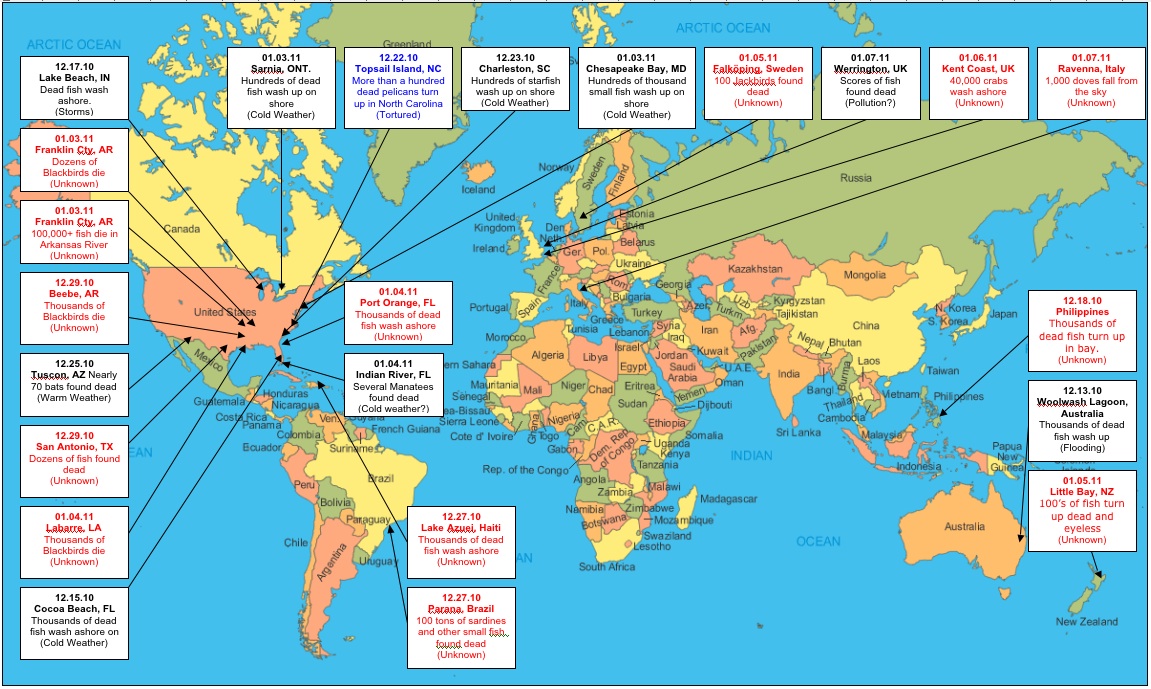
Timeline of recent mysterious bird, fish deaths


(NaturalNews) The recent mysterious deaths of birds and fish are causing alarm among naturalists around the world. Birds are literally falling dead out of the sky, and fish are washing up dead on shores and rivers across North America and around the world. The reaction from the mainstream media seems strangely subdued, as if they're all just blowing this off as some unexplained quirk about the natural world that should be largely ignored.

NaturalNews readers think differently. We are concerned when thousands of dead birds fall out of the sky for no apparent reason. The sky itself may not be falling, but previously live animals are clearly falling out of it. If that's not enough reason to wonder what the heck is happening to our planet, then what is?

These are clear signs that something is wrong. Red flags from nature, if you will. Here's the timeline of recent deaths that have been reported:

12.13.10 - Thousands of dead barramundi fish wash up in Australia, unknown causes (http://www.themorningbulletin.com.a...)

12.15.10 - Thousands of dead fish wash ashore on Florida beach, blamed on cold weather (http://www.cfnews13.com/article/new...)

12.17.10 - Dead fish wash ashore at lake beach in Indiana, blamed on winter storms (http://www.wndu.com/localnews/headl...)

12.18.10 - Thousands of dead fish turn up in bay in Philippines, unknown causes (http://globalnation.inquirer.net/ce...)

12.22.10 - More than a hundred dead pelicans turn up in North Carolina, unknown causes (http://www.carteretnewstimes.com/ar...)

12.23.10 - Hundreds of dead sea creatures wash ashore in South Carolina, blamed on cold water (http://www.abcnews4.com/Global/stor...)

12.23.10 - Ten tons of mostly dead fish found in fishing net in New Zealand, unknown causes (http://www.stuff.co.nz/auckland/loc...)

12.27.10 - Scores of dead fish wash ashore in a lake in Haiti, unknown causes (http://www.france24.com/en/20101227...)

12.28.10 - 70 bats found dead in Tucson, Ariz., unknown causes (http://www.azcentral.com/news/artic...)

12.29.10 - Dozens of fish found dead in San Antonio, Texas, unknown causes (http://www.ksat.com/news/26316464/d...)

12.31.10 - 5,000+ birds found dead in Arkansas, suffering from massive trauma and blood clots (http://www.cnn.com/2011/US/01/03/ar...)

01.03.11 - 100,000+ dead drum fish found in Arkansas river, unknown causes (http://www.todaysthv.com/news/local...)

01.03.11 - Dozens of dead birds show up in a woman's backyard in Kentucky, unknown causes (http://www.wpsdlocal6.com/news/loca...)

01.03.11 - Tens of thousands of dead fish wash ashore in Chesapeake Bay, Md., blamed on cold water (http://www.wbaltv.com/r/26357581/de...)

01.03.11 - 100 tons of dead fish wash ashore in Brazil, unknown causes (http://www.care2.com/greenliving/10...)

01.04.11 - Several dead manatees found on Florida coast, unknown causes (http://www.orlandosentinel.com/news...)

01.04.11 - Thousands of dead fish wash up on creek in Florida, unknown causes (http://www.wftv.com/news/26367953/d...)

01.04.11 - Hundreds of dead fish was ashore on St. Clair River in Ontario, Can., unknown causes (http://www.torontosun.com/news/cana...)

01.04.11 - Hundreds of dead black birds found on highway in Louisiana, suffering from internal injuries and blood clots (http://www.2theadvocate.com/news/11...)

01.05.11 - Hundreds of dead birds found on highway in Texas, unknown causes (http://www.ktre.com/global/story.as...)

01.05.11 - Large amount of dead fish wash up on New Zealand beaches, unknown causes (http://www.nzherald.co.nz/nz/news/a...)

01.05.11 - Up to 100 jackdaw birds found dead on road in Sweden, unknown causes (http://www.thelocal.se/31262/20110105/)

01.06.11 - 40,000+ dead Devil crabs washed ashore in the U.K., unknown causes (http://www.cbsnews.com/8301-503543_...)

01.07.11 - More than 1,000 dead turtle doves found in Italy, unknown causes (http://www.telegraph.co.uk/news/wor...)

01.10.11 - Countless fish found dead in U.K. brook, unknown causes (http://www.peterboroughtoday.co.uk/...)

01.11.11 - Thousands of gizzard shad fish float to the top of Lake Michigan and wash up on the shores near Chicago, blamed on cold weather (http://www.hispanicallyspeakingnews...)


Learn more: http://www.naturalnews.com/030985_mysterious_deaths_birds.html#ixzz1AwxJNjPd

Children need more meditation and less stimulation

If you want your children to feel more relaxed and less stressed, give them silence, not iPods.

This unthinkable idea came to mind after listening to Ernie Christie and Dr Cathy Day, two educationists from Queensland, Australia. They were addressing an audience at Regent's College, London, on the benefits of allowing children to experience regular periods of silent meditation in the classroom.

A pilot study in 2005, involving teaching meditation to five- to 17-year-olds, had shown that children are not only capable of meditation, they actually enjoy it. The benefits to children's wellbeing were so obvious to teachers that it persuaded Cathy Day, director of Townsville Catholic Education Office, to spend precious funds implementing the first Christian meditation programme for all schools in the diocese.

The initiative had two important catalysts: a diocesan bishop sympathetic to meditation, Michael Putney, and the input of Laurence Freeman OSB, leader of the World Community for Christian Meditation. Without their help, Day admitted, nothing would have got off the ground. When an almost pathological "busyness" is the norm, valuing stillness and silence is counter-cultural. When our culture trains us to be winners, to compete and to consume, we all sense society's imbalance, said Freeman. We need to give children an experience of another way of relating to themselves and to others.

Deputy director Christie agreed. If children are over-stimulated we rob them of something precious: being allowed to "just be" where children discover their own inner sense of who they are. Hijacked by a "doing" culture that measures everything by what we achieve or possess, meditation helps children access a deeper part of themselves - an inner sanctuary away from a world of incessant activity and noise. They learn to honour their own spiritual life.

We all have a spiritual life, irrespective of any faith we hold, said Christie. Meditation can be practised with a diversity of beliefs: children of other faiths take part in the programme. Meditating in a group can give children an early sense of belonging, says Christie. Children with learning or physical disabilities can join in and feel part of the class. But the practice is introduced gradually. The recommended meditation time is one minute per age level; for five- and six-year-olds, it would be five to six minutes.

A video of interviews with teachers, children and parents was admirably honest. Children of varying ages said meditation helped them to feel "relaxed" or more "peaceful". One boy said it helped his thoughts "just settle"; one girl enjoyed being "quiet". A child from an indigenous community said he was able "to be himself". Teachers reported improved behaviour in difficult children. Yet no one suggested it was a "cure all" practice. But at a recent awards ceremony in the second largest school in Townsville, the key speech was on the positive benefits of meditation.

The health benefits of meditation are well documented: it can relieve stress, lower blood pressure and alleviate depression. Psychiatrist Jonathan Champion said research showed most mental health problems have begun by the age of 14. Giving children periods of quietness and reflection to promote wellbeing could save money on healthcare later.

For Day and her team, meditation is an essential part of religious education. In the foreword to Christie's ground-breaking book, Coming Home: A Guide to Teaching Christian Meditation to Children, Putney says being "still" is very different from being "quiet". "Be still and know that I am God." It is in stillness that God speaks to the heart. Meditation as a way to self-knowledge and self-acceptance is an indispensable first step towards knowledge of God. Teachers hope children will discover a love that accepts them unconditionally and an inner spiritual resource they can draw upon later in life.

When religious schools are seen as intolerant of other faiths, the lost "contemplative" dimension of religion that reaches to a divine source beyond individual differences is surely needed. By training teachers in this depth dimension of faith, this remote diocese on the edge of the Australian outback is already creating waves.

Comment: A very beneficial meditation program for children is the Eiriu Eolas. For more information, please see this link:

EEbreathe.org

Toowoomba Flood 2011.01.10

Monday, January 3, 2011

African Farmers Displaced As Investors Move In


Soumouni, Mali - The half-dozen strangers who descended on this remote West African village brought its hand-to-mouth farmers alarming news: their humble fields, tilled from one generation to the next, were now controlled by Libya's leader, Col. Muammar el-Qaddafi, and the farmers would all have to leave.

"They told us this would be the last rainy season for us to cultivate our fields; after that, they will level all the houses and take the land," said Mama Keita, 73, the leader of this village veiled behind dense, thorny scrubland. "We were told that Qaddafi owns this land."

Across Africa and the developing world, a new global land rush is gobbling up large expanses of arable land. Despite their ageless traditions, stunned villagers are discovering that African governments typically own their land and have been leasing it, often at bargain prices, to private investors and foreign governments for decades to come.

Organizations like the United Nations and the World Bank say the practice, if done equitably, could help feed the growing global population by introducing large-scale commercial farming to places without it.

But others condemn the deals as neocolonial land grabs that destroy villages, uproot tens of thousands of farmers and create a volatile mass of landless poor. Making matters worse, they contend, much of the food is bound for wealthier nations.

"The food security of the country concerned must be first and foremost in everybody's mind," said Kofi Annan, the former United Nations secretary general, now working on the issue of African agriculture. "Otherwise it is straightforward exploitation and it won't work. We have seen a scramble for Africa before. I don't think we want to see a second scramble of that kind."

A World Bank study released in September tallied farmland deals covering at least 110 million acres - the size of California and West Virginia combined - announced during the first 11 months of 2009 alone. More than 70 percent of those deals were for land in Africa, with Sudan, Mozambique and Ethiopia among those nations transferring millions of acres to investors.

Before 2008, the global average for such deals was less than 10 million acres per year, the report said. But the food crisis that spring, which set off riots in at least a dozen countries, prompted the spree. The prospect of future scarcity attracted both wealthy governments lacking the arable land needed to feed their own people and hedge funds drawn to a dwindling commodity.

"You see interest in land acquisition continuing at a very high level," said Klaus Deininger, the World Bank economist who wrote the report, taking many figures from a Web site run by Grain, an advocacy organization, because governments would not reveal the agreements. "Clearly, this is not over."

The report, while generally supportive of the investments, detailed mixed results. Foreign aid for agriculture has dwindled from about 20 percent of all aid in 1980 to about 5 percent now, creating a need for other investment to bolster production.

But many investments appear to be pure speculation that leaves land fallow, the report found. Farmers have been displaced without compensation, land has been leased well below value, those evicted end up encroaching on parkland and the new ventures have created far fewer jobs than promised, it said.

The breathtaking scope of some deals galvanizes opponents. In Madagascar, a deal that would have handed over almost half the country's arable land to a South Korean conglomerate helped crystallize opposition to an already unpopular president and contributed to his overthrow in 2009.

People have been pushed off land in countries like Ethiopia, Uganda, the Democratic Republic of Congo, Liberia and Zambia. It is not even uncommon for investors to arrive on land that was supposedly empty. In Mozambique, one investment company discovered an entire village with its own post office on what had been described as vacant land, said Olivier De Schutter, the United Nations food rapporteur.


© The New York Times
Deals for farmland have involved many African nations.
In Mali, about three million acres along the Niger River and its inland delta are controlled by a state-run trust called the Office du Niger. In nearly 80 years, only 200,000 acres of the land have been irrigated, so the government considers new investors a boon.

"Even if you gave the population there the land, they do not have the means to develop it, nor does the state," said Abou Sow, the executive director of Office du Niger.

He listed countries whose governments or private sectors have already made investments or expressed interest: China and South Africa in sugar cane; Libya and Saudi Arabia in rice; and Canada, Belgium, France, South Korea, India, the Netherlands and multinational organizations like the West African Development Bank.

In all, Mr. Sow said about 60 deals covered at least 600,000 acres in Mali, although some organizations said more than 1.5 million acres had been committed. He argued that the bulk of the investors were Malians growing food for the domestic market. But he acknowledged that outside investors like the Libyans, who are leasing 250,000 acres here, are expected to ship their rice, beef and other agricultural products home.

"What advantage would they gain by investing in Mali if they could not even take their own production?" Mr. Sow said.

As with many of the deals, the money Mali might earn from the leases remains murky. The agreement signed with the Libyans grants them the land for at least 50 years simply in exchange for developing it.

"The Libyans want to produce rice for Libyans, not for Malians," said Mamadou Goita, the director of a nonprofit research organization in Mali. He and other opponents contend that the government is privatizing a scarce national resource without improving the domestic food supply, and that politics, not economics, are driving events because Mali wants to improve ties with Libya and others.

The huge tracts granted to private investors are many years from production. But officials noted that Libya already spent more than $50 million building a 24-mile canal and road, constructed by a Chinese company, benefiting local villages.

Every farmer affected, Mr. Sow added, including as many as 20,000 affected by the Libyan project, will receive compensation. "If they lose a single tree, we will pay them the value of that tree," he said.

But anger and distrust run high. In a rally last month, hundreds of farmers demanded that the government halt such deals until they get a voice. Several said that they had been beaten and jailed by soldiers, but that they were ready to die to keep their land.

"The famine will start very soon," shouted Ibrahima Coulibaly, the head of the coordinating committee for farmer organizations in Mali.
"If people do not stand up for their rights, they will lose everything!"
"Ante!" members of the crowd shouted in Bamanankan, the local language. "We refuse!"

Kassoum Denon, the regional head for the Office du Niger, accused the Malian opponents of being paid by Western groups that are ideologically opposed to large-scale farming.

"We are responsible for developing Mali," he said. "If the civil society does not agree with the way we are doing it, they can go jump in a lake."

The looming problem, experts noted, is that Mali remains an agrarian society. Kicking farmers off the land with no alternative livelihood risks flooding the capital, Bamako, with unemployed, rootless people who could become a political problem.

"The land is a natural resource that 70 percent of the population uses to survive," said Kalfa Sanogo, an economist at the United Nations Development Program in Mali. "You cannot just push 70 percent of the population off the land, nor can you say they can just become agriculture workers." In a different approach, a $224 million American project will help about 800 Malian farmers each acquire title to 12 acres of newly cleared land, protecting them against being kicked off.

Jon C. Anderson, the project director, argued that no country has developed economically with a large percentage of its population on farms. Small farmers with titles will either succeed or have to sell the land to finance another life, he said, though critics have said villagers will still be displaced.

"We want a revolutionized relationship between the farmer and the state, one where the farmer is more in charge," Mr. Anderson said.

Soumouni sits about 20 miles from the nearest road, with wandering cattle herders in their distinctive pointed straw hats offering directions like, "Bear right at the termite mound with the hole in it."

Sekou Traoré, 69, a village elder, was dumbfounded when government officials said last year that Libya now controlled his land and began measuring the fields. He had always considered it his own, passed down from grandfather to father to son.

"All we want before they break our houses and take our fields is for them to show us the new houses where we will live, and the new fields where we will work," he said at the rally last month.

"We are all so afraid," he said of the village's 2,229 residents. "We will be the victims of this situation, we are sure of that."

Agents Search Home of Pilot Critical of TSA


An airline pilot is being disciplined by the Transportation Security Administration (TSA) for posting video on YouTube pointing out what he believes are serious flaws in airport security.

The 50-year-old pilot, who lives outside Sacramento, asked that neither he nor his airline be identified. He has worked for the airline for more than a decade and was deputized by the TSA to carry a gun in the cockpit.

He is also a helicopter test pilot in the Army Reserve and flew missions for the United Nations in Macedonia.

Three days after he posted a series of six video clips recorded with a cell phone camera at San Francisco International Airport, four federal air marshals and two sheriff's deputies arrived at his house to confiscate his federally-issued firearm. The pilot recorded that event as well and provided all the video to News10.

At the same time as the federal marshals took the pilot's gun, a deputy sheriff asked him to surrender his state-issued permit to carry a concealed weapon.

A follow-up letter from the sheriff's department said the CCW permit would be reevaluated following the outcome of the federal investigation.

The YouTube videos, posted Nov. 28, show what the pilot calls the irony of flight crews being forced to go through TSA screening while ground crew who service the aircraft are able to access secure areas simply by swiping a card.

"As you can see, airport security is kind of a farce. It's only smoke and mirrors so you people believe there is actually something going on here," the pilot narrates.

Video shot in the cockpit shows a medieval-looking rescue ax available on the flight deck after the pilots have gone through the metal detectors. "I would say a two-foot crash ax looks a lot more formidable than a box cutter," the pilot remarked.

A letter from the TSA dated Dec. 6 informed the pilot that "an administrative review into your deputation status as a Federal Flight Deck Officer has been initiated."

According to the letter, the review was directly related to the discovery by TSA staff of the YouTube videos. "The content and subject of these videos may have violated regulations concerning disclosure of sensitive security information," the letter said.

The pilot's attorney, Don Werno of Santa Ana, said he believed the federal government sent six people to the house to send a message.

"And the message was you've angered us by telling the truth and by showing America that there are major security problems despite the fact that we've spent billions of dollars allegedly to improve airline safety," Werno said.

The pilot said he is not in trouble with his airline, but a supervisor asked him to remove public access to the YouTube videos.

He does, however, face potential civil penalties from the TSA. He said he would likely go public when it becomes clear what the government plans to do with him.

Tuesday, December 28, 2010

Rosalind Peterson: The Chemtrail Cover-Up

Contrails: The Real Reason


The word 'chemtrails' is a knock off of the word 'contrails.' Contrails are trails of condensation that can be seen in the sky when a jet airplane is traveling at above 30,000 feet altitude.

p there, almost 6 miles high, the air is thinner and colder -- very cold. Outside temperatures can dip to minus 60 F and the air is often full of minute ice crystals that hang suspended and invisible. When these ice crystals get sucked into a hot jet engine they turn into a gas, like steam, and can be seen as puffy white cloud-like lines that follow behind the jets. They usually dissipate and fade away as the moisture once again returns to form invisible ice crystals.

"Chemtrails" are something different. They are often formed behind jet aircraft at a much lower altitude and seem to persist in the sky. They often have a different color from contrails and frequently exhibit a rainbow spectrum if lit just right from the sun.

The confusion between these two kinds of phenomenon is what made us hesitate to write about them in Viewzone. We figured that with the dramatic increase in air transportation ther would naturally be many more contrails in the sky and that worrying about this was just another form of modern paranoia.

In this article you will learn that chemtrails are real and contain aluminum particles. They have been sprayed in the atmosphere in an attempt to protect micro-circuitry and semiconductors -- primarily involved with avionics -- from atmospheric and solar radiation that causes them to fail.


A satellite photo taken January 29, 2004, showing aircraft trails over SE America.
[click for larger view]

In the photo above, not all of the white lines are "chemtrails." Probably most are regular contrails or "con"densation trails from jet commercial airline flights. It just illustrates the severity of the problem -- even without any conspiracy.

The conspiracy, however, adds another degree of complexity to the problem. It claims that certain trails are not a mere byproduct of modern aviation but rather a deliberate attempt to introduce cloud-like formations in the atmosphere, restricting our sunlight and possibly poisoning us with chemicals. Hence the term "chem"ical trails.

Chemtrails are real

The term "chemtrail" was first introduced by journalist, William Thomas, in 1997. He wrote about something that many people had been seeing in the skies above their homes all across America. It wasn't so much that people noticed the white trails from jets, or even that there appeared to more of them than they remembered in the past, but that the aircraft making these white lines were flying in unusual ways -- often in zig-zag patterns or making multiple parallel lines of white trails that tended to expand and eventually cover the sky with a canopy of clouds.


[Top: photo taken in Kentucky; Middle: photo taken in Washington;
Bottom: photo taken in Portland, Oregon]

Initially, people began to question the government, thinking it was some kind of weather control project, but NASA and NOAA and even the military have denied any knowledge or involvement in the phenomenon. Independent researchers, convinced that something is going on, have posed sinister theories which have gained acceptance from the government's apparent lack of interest and even ridicule of the idea that there is anything unusual.

Analysis of the trails is difficult, at least from the ground. But occasionally the trails have drifted to much lower altitudes and have apparently condensed to form strange residues that have been collected from trees, roofs and ponds.

Lab tests show chemtrails contain aluminum!

In 2008, samples around California's Lake Shasta and the Pit River Arm tributary were tested in a State Certified Lab following weeks of fly-overs and chemtrails. The results of the water samples showed 4,610,000 parts per million of aluminum -- 4610 times the maximum contaminant level! [6]

At another pond, filled with filtered water and confirmed to contain "0" aluminum, test revealed 375,000 parts per million of aluminum (375 times the maximum contaminant level) after only 18 months exposure to the aerial spraying.

The usually pristine snow pack from the Ski Bowl area of Mt. Shasta showed 61,000 parts per million of aluminum!

Why aluminum? Secrets revealed...

At first the logic of putting fine particles of aluminum in the atmosphere seems utterly strange. But a little research reveals that this plan was considered necessary many decades ago. In fact, the idea of spraying aluminum oxide from jet aircraft was patented by Hughes Aircraft in 1990 (see www.uspto.gov, patent #5003186). The plan proposed "to seed the metallic particles was to add the tiny particles to the fuel of jet airliners, so that the particles would be emitted from the jet engine exhaust while the airliner was at its cruising altitude."

SUMMARY OF THE INVENTION: Patent #5003186
A method is disclosed for reducing atmospheric warming due to the greenhouse effect resulting from a greenhouse gases layer. The method comprises the step of seeding the greenhouse gas layer with a quantity of tiny particles of materials characterized by wavelength-dependent emissivity or reflectivity, in that said materials have high emissivities in the visible and far infrared wavelength regions and low emissivity in the near infrared wavelength region. Such materials can include the class of materials known as Welsbach materials. The oxides of metal, e.g., aluminum oxide, are also suitable for the purpose. The greenhouse gases layer typically extends between about seven and thirteen kilometers above the earth's surface. The seeding of the stratosphere occurs within this layer. The particles suspended in the stratosphere as a result of the seeding provide a mechanism for converting the blackbody radiation emitted by the earth at near infrared wavelengths into radiation in the visible and far infrared wavelength so that this heat energy may be reradiated out into space, thereby reducing the global warming due to the greenhouse effect."

But wait! There's more.

A more sinister use of aluminum

You would think that the government would be happy to announce that they had a plan to help reduce global warming. If spraying powdered aluminum oxide from jetliners would stave off the dire predictions of violent storms, melting icecaps and rapidly rising ocean, most people would likely have applauded their attempts. There would have been no need for secrecy and denying what people have been seeing in the skies over their communities.

So is there really another reason for the chemtrails? Absolutely.

It was the late Edward Teller, member of the Manhattan Project and father of the Hydrogen Bomb, co-founder and director of the Lawrence Livermore National Laboratory, who proposed this geo-engineering technique together with Roderick Hyde and Lowell Wood and who designed a variety of mixtures according to the specific tasks they have to perform, among which figure the deployment of "electrically-conducting sheets" or "metallic 'nets' of ultra-fine mesh-spacing" in the stratosphere.

But their concern wasn't global warming. It was the growing dependence on, and vulnerability to semiconductors.

In a paper presented to the US Air Force titled "Electromagnetic Pulse Threats in 2010", Major Colin R. Miller describes the dangers from atmospheric radiation which could shut down everything in America -- bringing us back to the stone age. Disruption of semiconductors in our present society could cause everything to cease -- from the basics like water and power to emergency services, all communication, transportation and our national security. He outlines vital importance of shielding of these circuits, both individually and globally. [1]

In a 2009 interview with Ludwig Glinz about 'Sferic Frequencies, Semiconductor Technologies and their effective Preservation and Protection,' Uwe Behnken, founder of LiveNet Concept 2010 and long time activist against Chemtrail Spraying, suggests that the massive injection of toxic substances into the stratosphere ever since the nineties bears a direct relation to the protection of highly sensitive semiconductor technologies.

"Natural electromagnetic pulses are known to everybody ever since the film 'The Day After' where we learnt what happens if these are created artificially by means of the explosion of an atom bomb. If an atomic weapon explodes, the electromagnetic pulse causes semiconductor technologies to stop functioning. The same electromagnetic pulses can be registered in the event of elevated sferic frequencies or nuclear electromagnetic pulses stemming from elevated sun activities, and from our perspective this is another reason why it is undertaken to repel these sferic frequencies with the help of toxic substances, like aluminium oxides and barium-chlorides so as to protect semiconductor technologies."[see http://www.lnc-2010.de/Linkpool/Sfericstandard.wmv]
Our vulnerability to radiation

Since the 1950's when silicon and germanium transistors were suddenly "discovered" by Bell Laboratories, electronic circuitry has become entirely dependent upon these semiconductors. Radios containing vacuum tubes were replaced by transistor circuits and expensive room size computers, which used magnetic relays and solenoids, were quickly reduced to desktop "appliances" that are now found in most every home.

As we round the corner of the first decade of the 21st Century, micro-circuits are in our cellphones, satellites, "fly-by-wire" cars and almost all of the communications devices used by the financial, business and military institutions. In just 50 years since their introduction, semiconductors have become a most vital part of our life and a necessity for our survival.

But there's a problem no one anticipated.

Because the circuits are so incredibly small and function of such extremely low voltages, they are highly vulnerable to outside radiation. Rays from our Sun, the atmosphere and even cosmic rays, can and do cause errors in these circuits that can have an impact on the lives and safety of everyone.

Three little sins

One of the problems related to semiconductor technology and as derived from some of its specific characteristics is, that upon exposure to various types of particles of atmospheric radiation -- alpha particles, various ions, protons, and neutrons which can 'hit' the device -- it can change state or alter its output, leading to an error. This phenomenon is widely known by the manufacturers and has been called 'Single Event Effect' (SEE), which, in turn, is classified in three basic categories: A soft error or 'single event upset' (SEU), a soft or hard error or 'single event latch-up (SEL) and a hard failure or 'single event burnout' (SEB).


The Single Event Upset happens when the flow of data ("1's" and "0's") is corrupted. Maybe when reading the binary code from a memory or processor an extra bit is added or lost. This is a fairly regular occurrence and is usually corrected within the device by a special code that counts the number of bits, checks to make sure the same number was received, and orders them to be repeated if there is a discrepancy.

The Single Event Latch is more serious. The external radiation causes one of the transistors to malfunction, allowing high voltage to enter the circuit and disabling the device either temporarily or permanently. The damage is usually localized and many critical circuits have built in redundancy to compensate for this.

The Single Event Burnout results when the radiation causes instantaneous yet large voltages to enter the circuit, burning the internal elements of the transistors and their surrounding components. When this happens the electronic circuits are permanently disabled.

All of the problems mentioned happen to semiconductor circuits when exposed to radiation. Manufacturers of commercial semiconductors do not design any protection against this and so our society -- our way of life -- is highly vulnerable. The protection from such things as solar radiation and cosmic rays has instead been to establish a conductive layer of metallic particles which cover and dissipate this radiation.

In an Atmospheric Radiation Effects Whitepaper by Ken Vranish, titled "The Growing Impact of Atmospheric Radiation Effects on Semiconductor Devices and the Associated Impact on Avionics Suppliers" the problem is put in perspective. The design and manufacturing of complex devices usually allow for flaws and malfunctions that are tracked statistically. A failure or malfunction that happens once in 40,000 hours could be thought of as negligible. But if the malfunction is in a life critical system, such as the navigation or engine control of a passenger aircraft, this could be deadly.

Next, complex designs usually take about a decade to reach production. The circuitry in use today was designed before the problem of radiation was well understood. So there is virtually no protection in individual circuits. This shifts the burden to a global solution, especially with regards to aviation electronics, such as atmospheric seeding with metallic substances.

All of the above is especially true for military applications of semiconductors.

"Operations Enduring Freedom and Iraqi Freedom demonstrated the potential of NCW, allowing unprecedented speed and lethality through digital command, control, communications, and computers (C4) integrated throughout the battlespace. The ability of microchip-enabled systems to leverage combat power was eye watering and in the future will be paramount. Data links, displays, satellite communications, computerized planning systems, GPS receivers, radios, smart munitions, vehicles, aircraft, and all other systems required to support the networked force will derive their power, and potentially their doom, from fragile electronic systems..."[2]
Public outcry?

No doubt the public will feel disrespected when they learn that this fact has been hidden from them. But perhaps they will also take note of the many unusual airline tragedies that appear to be the result of some sudden electronic failure. Perhaps they will understand why automobile manufacturers, like Toyota, have not been up front about the vulnerabilities of today's fly-by-wire automotive controls that should have faraday shield, at the very least.

With the Solar Maximum approaching we can expect more and more failures of semiconductors, resulting is all sorts of malfunctions and potential burnouts. One strong Coronal Mass Ejection is all the it would take to trigger the dire scenario portrayed by Major Miller.

A history of lies and more lies...

Back in 2001, angry citizens had mustered enough physical evidence and thousands of photos and video tapes to make at least one congressman, Mr. Dennis Kucinich, include the phenomenon in a bill, (HR 2977) "The Space Preservation Act of 2001" where chemtrails were to be prohibited as an "exotic weapons system." After some closed door discussions, the bill was re-introduced (HR 3615) with this portion of the prohibition omitted.

A review of the average surface temperatures over the last decade shows a decrease of 0.5F, while atmospheric temperatures have undoubtedly been rising. Scientists attribute this to chemtrails.

Non-scientists have noticed that beautiful sunny days are often turned into overcast by the crazy zig-zag flights of jets and wonder if this could also cause droughts or respiratory illnesses. It's crazy, and no one in the government seems to want to address this.

The question remains unanswered: why won't the government come clean with the chemtrails? Is it because the aluminum and other metallic substances has also been responsible for poisoning our water and air? Is it because the need to shield military, corporate and business communications was a higher priority than the wellbeing of the average people? We need answers and we need them now.

Below are some recent articles that have been posted as an introduction to chemtrails. We encourae readers to comment and write to Viewzone's Editor.

The Known Universe by AMNH

Is the Gulf of Mexico safe?


Gulf shrimp being offloaded at Dean Blanchard Seafood
Distributors, Grand Isle, Louisiana [Erika Blumenfeld]


Experts, fishermen and residents disagree with federal agencies' claims that the Gulf and its seafood are safe.

Gulf Coast residents, fishermen, seafood distributors, and scientists believe that living on the coast and eating seafood from the Gulf has become hazardous to their health.

In response to their oil disaster last summer that released at least 4.9 million barrels of oil into the Gulf of Mexico, BP admitted to using at least 1.9 million gallons of widely banned toxic Corexit dispersants (which have been banned in 19 countries) to sink the oil. The dispersants contain chemicals that many scientists and toxicologists have warned are dangerous to humans, marine life, and wildlife.

Earlier this year on May 20, the EPA told BP it had 24 hours to find a less toxic alternative, but the EPA's request was ignored. Then on May 25, BP was given a directive by the EPA to scale back their spraying of the Gulf of Mexico with dispersants. The Coast Guard overlooked the EPA's directive and provided BP with 74 exemptions in 48 days to use the dispersants.

A March 1987 report titled Organic Solvent Neurotoxicity, by the National Institute for Occupational Safety and Health (NIOSH), states: "The acute neurotoxic effects of organic solvent exposure in workers and laboratory animals are narcosisanaesthesiaia, central nervous system (CNS) depression, respiratory arrest, unconsciousness, and death."

Several chemicals and chemical compounds listed in the NIOSH report, such as styrene, toluene, and xylene, are now present in the Gulf of Mexico as the result of BP’s dispersants mixing with BP's crude oil.

Government testing repudiated

On October 29 the US Food and Drug Administration (FDA) and National Oceanic and Atmospheric Administration (NOAA) announced in a press release, new chemical testing for BP's dispersants.

Prior to the federal government's announcement, a "rigorous sensory analysis" (a sniff test), was the only measure in place to test seafood samples for dispersant contamination. According to the press release, the new testing measure checks for the level of dioctyl sodium sulfosuccinate (known as DOSS), a major component of the dispersants.

Surprisingly, the press release admits to dispersant chemicals being present in some of their seafood samples: "Using this new, second test, in the Gulf scientists have tested 1,735 tissue samples ... Only a few showed trace amounts of dispersants residue (13 of the 1,735) and they were well below the safety threshold of 100 parts per million [ppm] for finfish and 500 parts per million for shrimp, crabs and oysters."

"This test adds another layer of information, reinforcing our findings to date that seafood from the Gulf remains safe," Jane Lubchenco, undersecretary for commerce and NOAA administrator, said of the test.

However the press release does not specify which type of analytical testing was carried out on what types of seafood, nor what the "trace amounts of dispersants" were. Al Jazeera's requests last week for this information from both NOAA and the FDA have not been answered.

Hugh Kaufman is a senior policy analyst at the Environmental Protection Agency's (EPA) office of solid waste and emergency response. Kaufman, a leading critic of the US government's decision to use Corexit, told Al Jazeera this about the press release: "They say it perfectly clear: the purpose of the test they developed is to make the public confident, not whether the seafood was safe or not.

"They selected the one compound that doesn’t bio-accumulate, as opposed to testing for the toxic ingredients that have a low safety threshold and do build up in tissue. They are not looking for those."

Kaufman, who has been the EPA's chief investigator on several contamination cases, including Love Canal and Times Beach, said: "They want to be able to tell the public the seafood is safe. But if you are going to test seafood to see if it’s safe or not, you want to test for the ingredients of Corexit that have a low safety threshold and do bio-accumulate in tissue."

"However, if you want the public to think everything is fine, then you do what they said in their press release they are doing, which is to look for an ingredient with a high safety threshold that doesn’t build up in tissue."

"They told you they are doing a cover up, how they are doing the cover up, and notwithstanding that, they still have some positive results for chemicals."

Inaccurate safety levels

Chemist Bob Naman with the Analytical Chemical Testing Lab in Mobile, Alabama, has been testing samples from across the Gulf for oil and dispersant also takes issue with these recent government statements.

"500 ppm is an incredible amount," Naman explained to Al Jazeera, "I don't know what moron set that level, but 500 ppm is an extreme amount. It is probably 100 times too high. A reasonably insignificant number would be five parts per billion [ppb], not something being tracked in ppm."

Naman gave an example of a government standard that seemingly undermines information in the recent press release.

"The amount of chemicals the EPA allows in storm water draining from a site containing salvaged cars into a body of water is 15 ppm," he said.

"If the EPA won’t allow more than 15 ppm of that, why in the hell would they consider a number that is 33 times higher than that as acceptable for something you are going to put in your body? Their people that are setting that kind of number apparently don't have a clue what that number even means. The threshold limits they are setting are extremely absurd to a chemist like me. I'm appalled they would use such high numbers for their thresholds."

Naman also expressed concern over the fact that from his understanding neither the FDA nor NOAA are testing for propylene glycol and 2-butoxyethanol, the two marker chemicals for BP’s dispersants.

"Since they are testing in ppm, these two marker compounds are not being picked up," Naman said.

"They are not using low enough detection limits. They need to be looking for parts per billion, not parts per million. It's a world of difference."

The EPA's website states that, "EPA believes dispersants should only be used sparingly and when absolutely necessary," yet conversely stated that while BP’s well was gushing oil, "[dispersants] appeared to be having a positive effect on the oil at the source of the leak and thus far has had no significant ecological impact".

Al Jazeera requested information from the EPA's Region 6 Public Information Centre about their ongoing testing of the water and air for chemicals associated with the oil disaster, also asking for information the EPA has that is related to illnesses caused by the oil disaster.

Last week we were told by Joe Hubbard in EPA's office of external affairs that this information would be provided, but Al Jazeera has yet to receive this information.

Kaufman believes one of the main problems with federal response to the oil disaster is that, "BP called most of the shots, and that was the problem, and clearly from this press release, looks like they still are. The more the public thinks everything is back to normal, the less people who were harmed by the mess will be reimbursed. Follow the money".


Karen Hopkins at Dean Blanchard Seafood Distributors, Grand Isle, Louisiana [Erika Blumenfeld]


Seafood concerns

Fisherman from Louisiana and Florida have voiced their concerns to Al Jazeera about the safety of seafood they are catching.

Karen Hopkins, who works for the seafood distributor Dean Blanchard Seafood, in Grand Isle, Louisiana, told Al Jazeera: "I will never again eat any seafood that comes from the Gulf of Mexico."

Clifford Troxler, also from Louisiana, worked in the seafood distribution business for 25 years, and told Al Jazeera: "You couldn’t force feed me a shrimp from the Gulf."

Hopkins is also concerned about what she sees as an attempt by the federal government to shift responsibility of seafood safety "away from BP and the feds and placing it square on the shoulders of fishermen and distributors".

Hopkins provided Al Jazeera with a letter from Best Sea-Pak, a seafood distributor Dean Blanchard Seafood works with, that says: "Due to the recent Deepwater Horizon oil spill in the Gulf of Mexico and customers concerns of oil tainted seafood, we must implement measures to prevent oil tainted seafood from entering the food supply.

"A new mandatory requirement by the United States Food and Drug Administration is to ensure no fish (seafood) may be harvested from an area that is covered by a Local, State, or Federal closure or for which there is additional information that indicates potential hazards related to an oil spill."

"Our lawyers looked this over and told us it is basically an attempt to make us and the fishermen take full responsibility for the seafood, even though it has been BP and the feds that have pushed to open up all the previously closed waters for fishing," Hopkins said.

"That means that we’ll be the ones who get sued if somebody gets sick from contaminated seafood, instead of BP or the feds, who are the ultimately the responsible parties for all of this in the first place."

Ongoing sickness

Al Jazeera is finding a growing number of people along the Gulf Coast who are exhibiting symptoms they attribute to chemical poisoning and exposure to BP's oil and dispersants.

Susan Price is a small business owner who lives in Chauvin, Louisiana. While volunteering for a community outreach program in Grand Isle, Louisiana in late August, Price became ill.

"When I drove over the bridge to Grand Isle, I felt heavy exposure to chemicals," Price told Al Jazeera. "My nose instantly clogged, I began to cough, my throat hurt, my voice became instantly hoarse, and my tongue felt and tasted like I'd licked a battery."

A return trip to the island a short while later brought her symptoms back, so Price saw a doctor.

"I was diagnosed with pneuminitis, which is an inflammation of the lungs that the doctor told me is caused by inhalation of chemicals," Price said. "He gave me an inhaler and pumped me up with antibiotics, but I’m still sick."

Furthermore, Price said that while she was engaged in her community outreach work on Grand Isle, "every person I was dealing with was sick and had the same symptoms I did. Those people that are living there, heaven help them".

Donny Matsler, a commercial fisherman from Dauphin Island, Alabama, has been suffering acute symptoms for months that have led him to several emergency room visits, time in intensive care, and finally to detoxification treatment with Dr William Rea in Dallas, Texas, at the Environmental Health Center.

The centre tests and treats human health problems related to chemical exposure, among other environment related ailments.

"Dr Rea told me I am Corexit-drunk," Matsler told Al Jazeera, "My wife is the same, and everybody in Dauphin Island is sick from this stuff."

BP dispersants causing sickness


Investigation by Al Jazeera online correspondent finds toxic illnesses linked to BP oil dispersants along Gulf coast.

Two-year-old Gavin Tillman of Pass Christian, Mississippi, has been diagnosed with severe upper respiratory, sinus, and viral infections. His temperature has reached more than 39 degrees since September 15, yet his sicknesses continue to worsen.

His parents, some doctors, and environmental consultants believe the child's ailments are linked to exposure to chemicals spilt by BP during its Gulf of Mexico oil disaster.

Gavin's father, mother, and cousin, Shayleigh, are also facing serious health problems. Their symptoms are being experienced by many others living along the coast of the Gulf of Mexico.

Widely banned toxic dispersants

Injected with at least 4.9 million barrels of oil during the BP oil disaster of last summer, the Gulf has suffered the largest accidental marine oil spill in history. Compounding the problem, BP has admitted to using at least 1.9 million gallons of widely banned toxic dispersants (one that has been banned in the UK), which according to chemist Bob Naman, create an even more toxic substance when mixed with crude oil. And dispersed, weathered oil continues to flow ashore daily.

Naman, who works at the Analytical Chemical Testing Lab in Mobile, Alabama, has been carrying out studies to search for the chemical markers of the dispersants BP used to both sink and break up its oil.

According to Naman, poly-aromatic hydrocarbons (PAHs) from this toxic mix are making people sick. PAHs contain compounds that have been identified as carcinogenic, mutagenic, and teratogenic.

Fisherman across the four states most heavily affected by the oil disaster - Louisiana, Mississippi, Alabama, and Florida - have reported seeing BP spray dispersants from aircraft and boats offshore.

"The dispersants are being added to the water and are causing chemical compounds to become water soluble, which is then given off into the air, so it is coming down as rain, in addition to being in the water and beaches of these areas of the Gulf," Naman added.

"I’m scared of what I'm finding. These cyclic compounds intermingle with the Corexit [dispersants] and generate other cyclic compounds that aren’t good. Many have double bonds, and many are on the EPA's danger list. This is an unprecedented environmental catastrophe."

Commercial fisherman Donny Matsler also lives in Alabama.

"I was with my friend Albert, and we were both slammed with exposure," Matsler explained of his experience on August 5, referring to toxic chemicals he inhaled that he believes are associated with BP's dispersants. "We both saw the clumps of white bubbles on the surface that we know come from the dispersed oil."

Gruesome symptoms

"I started to vomit brown, and my pee was brown also," Matsler, a Vietnam veteran who lives in Dauphin Island, said. "I kept that up all day. Then I had a night of sweating and non-stop diarrhea unlike anything I’ve ever experienced."

He was also suffering from skin rashes, nausea, and a sore throat.

At roughly the same time Matsler was exposed, local television station WKRG News 5 took a water sample from his area to test for dispersants. The sample literally exploded when it was mixed with an organic solvent separating the oil from the water.

Naman, the chemist who analyzed the sample, said: "We think that it most likely happened due to the presence of either methanol or methane gas or the presence of the dispersant Corexit."

"I'm still feeling terrible," Matsler told Al Jazeera recently. "I'm about to go to the doctor again right now. I'm short of breathe, the diarrhea has been real bad, I still have discoloration in my urine, and the day before yesterday, I was coughing up white foam with brown spots in it."

As for Matsler's physical reaction to his exposure, Hugh Kaufman, an EPA whistleblower and analyst, has reported this of the effects of the toxic dispersants:

"We have dolphins that are hemorrhaging. People who work near it are hemorrhaging internally. And that’s what dispersants are supposed to do..."

By the middle of last summer, the Alabama Department of Public Health said that 56 people in Mobile and Baldwin counties had sought treatment for what they believed were oil disaster-related illnesses.


A dispersed oil tar ball in Orange Beach, Alabama [Erika Blumenfeld]


"The dispersants used in BP's draconian experiment contain solvents such as petroleum distillates and 2-butoxyethanol," Dr. Riki Ott, a toxicologist, marine biologist, and Exxon Valdez survivor, told Al Jazeera.

"Solvents dissolve oil, grease, and rubber," she continued, "Spill responders have told me that the hard rubber impellors in their engines and the soft rubber bushings on their outboard motor pumps are falling apart and need frequent replacement."

"Given this evidence, it should be no surprise that solvents are also notoriously toxic to people, something the medical community has long known," Dr. Ott added.

"In 'Generations at Risk', medical doctor Ted Schettler and others warn that solvents can rapidly enter the human body. They evaporate in air and are easily inhaled, they penetrate skin easily, and they cross the placenta into fetuses. For example, 2- butoxyethanol (in Corexit) is a human health hazard substance; it is a fetal toxin and it breaks down blood cells, causing blood and kidney disorders."

Pathways of exposure to the dispersants are inhalation, ingestion, skin, and eye contact. Health impacts include headaches, vomiting, diarrhea, abdominal pains, chest pains, respiratory system damage, skin sensitization, hypertension, central nervous system depression, neurotoxic effects, genetic mutations, cardiac arrhythmia, and cardiovascular damage.

Even the federal government has taken precautions for its employees. US military officials decided to reroute training flights in the Gulf region in order to avoid oil and dispersant tainted-areas.

Growing number of cases

And Al Jazeera is finding a growing number of illnesses across the Gulf Coast.

Denise Rednour of Long Beach, Mississippi, has been taking walks on Long Beach nearly every day since the disaster began on April 20, and she is dealing with constant health issues.

"I've had health problems since the middle of July," she said. "At the end of August, I came home from walking on the beach and for four days had bloody, mucus-filled diarrhea, dry heaves, and blood running out of my ear."

Karen Hopkins, in Grand Isle, Louisiana, has been sick since the middle of May. "I started feeling exhausted, disoriented, dizzy, nauseous, and my chest was burning and I can’t breath well at times," she said.

Dean Blanchard, who runs a seafood distribution business in Grand Isle, is Hopkins' boss. He too is experiencing similar symptoms.

"They [BP] are using us like lab rats," he explained, "I'm thinking of moving to Costa Rica. When I leave here I feel better. When I come back I feel bad again. Feeling tired, coughing, sore throat, burning eyes, headaches, just like everyone around here feels."

Lorrie Williams of Ocean Springs says her son's asthma has "gotten exponentially worse since BP released all their oil and dispersants into the Gulf."

"A plane flew over our house recently and sprayed what I believe are dispersants. A fine mist covered everything, and it smelled like pool chemicals. Noah is waking up unable to breath, and my husband has head and chest congestion and burning eyes," Williams said.

Like others, when Lorrie's family left the area for a vacation, they immediately felt better. But upon coming home, their symptoms returned.

Wilma Subra, a chemist in New Iberia, Louisiana, recently tested the blood of eight BP cleanup workers and residents in Alabama and Florida. "Ethylbenzene, m,p-Xylene and Hexane are volatile organic chemicals that are present in the BP Crude Oil," Subra said,

"The blood of all three females and five males had chemicals that are found in the BP Crude Oil. The acute impacts of these chemicals include nose and throat irritation, coughing, wheezing, lung irritation, dizziness, light-headedness, nausea and vomiting."

Indications of exposure

Subra explained that there has been long enough exposure so as to create chronic impacts, that include "liver damage, kidney damage, and damage to the nervous system. So the presence of these chemicals in the blood indicates exposure."

Testing by Subra has also revealed PAHs present "in coastal soil sediment, wetlands, and in crab, oyster and mussel tissues."

Trisha Springstead, is a registered nurse of 36 years who lives and works in Brooksville, Florida.

"What I'm seeing are toxified people who have been chemically poisoned," she said, "They have sore throats, respiratory problems, neurological problems, lesions, sores, and ulcers. These people have been poisoned and they are dying. Drugs aren’t going to help these people. They need to be detoxed."

Chemist Bob Naman described the brownish, rubbery tar balls that are a product of BP's dispersed oil that continue to wash up on beaches across the Gulf:

"Those are the ones kids are picking up and playing with and breathing the fumes that come off them when you crush them in your hand. These will affect anyone who comes into contact with it. You could have an open wound and this goes straight in. Women have a lot more open mucus membranes and they are getting sicker than men. They are bleeding from their vagina and anus. Small kids are bleeding from their ears. This stuff is busting red blood cells."

Dr Ott said: "People are already dying from this… I’m dealing with three autopsies' right now. I don’t think we’ll have to wait years to see the effects like we did in Alaska, people are dropping dead now. I know two people who are down to 4.75 per cent of their lung capacity, their heart has enlarged to make up for that, and their esophagus is disintegrating, and one of them is a 16-year-old boy who went swimming in the Gulf."

This strange weather phenomenon, which you will see in the video below, happened in Newfoundland where the waves were actually frozen as they crashed


EMBED-Newfoundland Frozen Waves - Watch more free videos

Atlantis and the Anunnaki

New Giant Skulls Found!

My Blog List